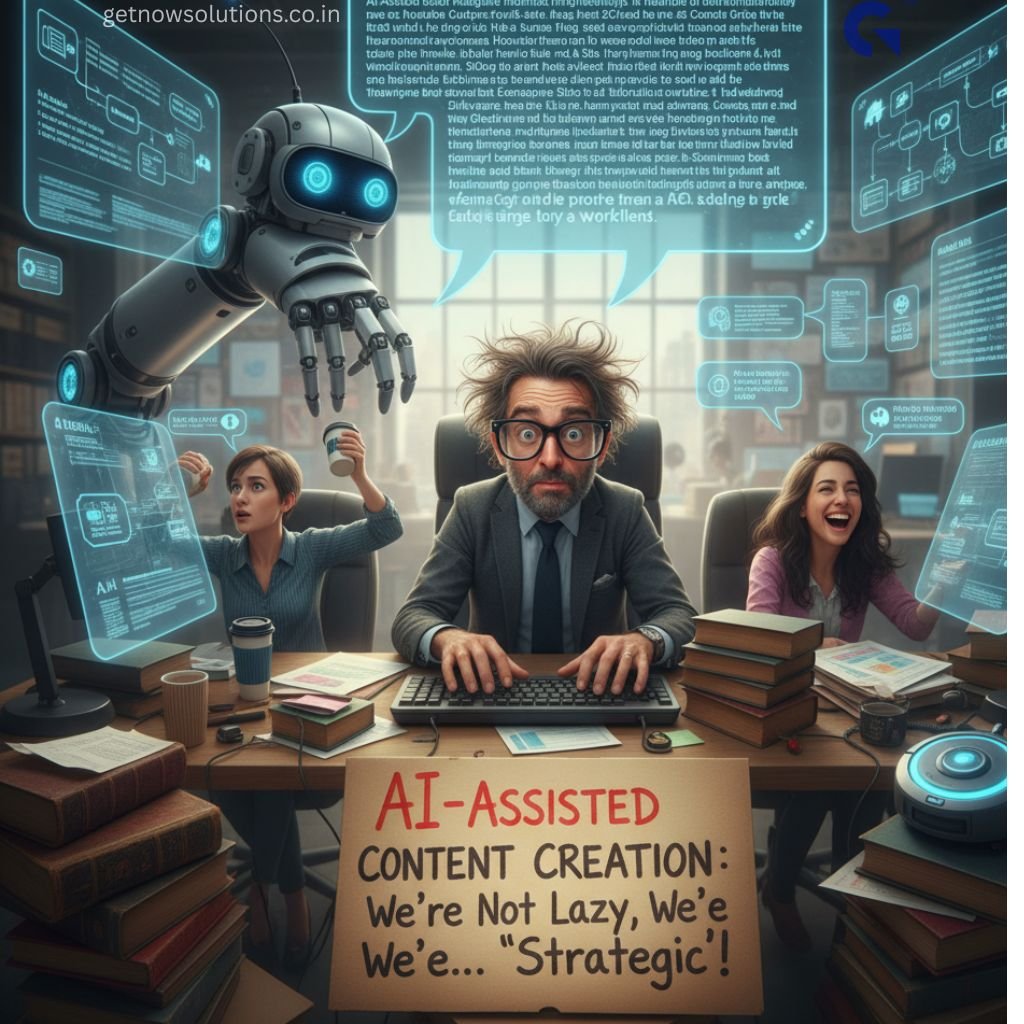
Executive Summary: What Is AI-Assisted Content Creation?
AI-Assisted Content Creation is the strategic fusion of human creativity and artificial intelligence to plan, generate, optimize, and scale digital content efficiently. This hybrid content model leverages machine learning, Natural Language Processing (NLP), and automation tools to streamline content production while maintaining human oversight for accuracy, tone, and authenticity.
The Evolution of the Hybrid Content Model
AI isn’t replacing marketers — it’s augmenting them. Modern enterprises now adopt a Hybrid Content Model, where humans guide Generative AI systems through prompt engineering and contextual validation. According to SEMrush’s 2024 Content Marketing Report, 82% of organizations using AI tools reported improved productivity, while 68% achieved measurable SEO growth within six months.
At the enterprise level, AI tools such as Jasper, Ryer, Grammarly GO, and SEMrush Content Toolkit have become integral parts of the algorithmic content supply chain. These tools automate repetitive stages — from keyword clustering to tone optimization — allowing content strategists to focus on creativity, storytelling, and compliance with Google’s E-E-A-T (Experience, Expertise, Authority, Trustworthiness) standards.
Quantifying the ROI of AI Content Tools
How do I measure the ROI of AI content tools?
The ROI of AI-assisted systems is best captured through operational efficiency and business outcomes. On average, companies integrating AI content workflows report:
- 30% reduction in Cost per Content Asset (CPA)
- 20% increase in content-driven conversions
- 98 hours saved per employee annually
- 40% faster go-to-market cycles
For CMOs, this efficiency dividend directly translates into higher marketing velocity and consistent brand communication across multiple channels. ROI measurement should track metrics such as content throughput, engagement uplift, time-to-publish, and conversion rate improvement post-AI adoption.
The 4-Stage AI Content Workflow Automation Process
What is the 4-stage process for AI content workflow automation?
Enterprise-grade AI content workflows operate on a structured automation model that ensures scalability, quality control, and compliance.
1. Data Processing:
AI tools collect and analyze data from keyword databases, competitor insights, and user intent signals. APIs connect analytics systems (e.g., Google Search Console, Ahrefs) to contextualize topic opportunities.
2. Content Generation:
Using trained Generative AI models, the system produces first drafts or outlines based on input prompts, brand voice parameters, and SERP analysis.
3. Iteration and Quality Assurance:
Human editors validate factual accuracy, add unique insights, and optimize for readability, tone, and E-E-A-T alignment. Integration with AI Quality Assurance APIs ensures linguistic consistency and bias control.
4. Deployment and Optimization:
Approved content is published through CMS-integrated APIs, tracked using performance analytics dashboards. Continuous A/B testing refines both creative and SEO elements over time.
Ensuring E-E-A-T Compliance in AI-Generated Content
How do I ensure AI content meets Google’s E-E-A-T standards?
Google’s Helpful Content System clarifies that AI-generated material is acceptable — as long as it’s helpful, accurate, and human-reviewed. To align AI outputs with E-E-A-T:
- Add Human Experience: Include personal observations, real-world data, or expert commentary to fulfil the “Experience” component.
- Validate Authority: Cite reputable, verifiable sources such as Google documentation, SEMrush studies, or industry whitepapers.
- Build Trust: Disclose the use of AI in your process, and ensure editorial review by subject-matter experts.
- Ensure Originality: Avoid duplicate or template-style content by enriching each piece with contextually unique insights.
This Human-in-the-Loop validation is vital to prevent factual inaccuracies and to protect brand integrity against AI hallucinations.
Scaling and Repurposing: 10x Content Efficiency
How can I use AI for content repurposing and scaling (10x content variants)?
AI allows marketers to repurpose long-form assets into multiple derivative formats with 10x efficiency. A single research article can be converted into:
- Short-form social media snippets
- LinkedIn thought-leadership posts
- Video or podcast scripts
- Email newsletters and infographics
Automation tools such as Descript, ChatGPT API, and Lumen5 streamline this process, cutting editing time by up to 80%. For example, marketers can use AI to transform one webinar transcript into five optimized blog posts, 20 LinkedIn posts, and an entire email campaign — without compromising message consistency.
Enterprise Integration: Challenges and Future Outlook
Data Integrity and Proprietary Datasets
The next phase of AI content creation depends on data ownership. Enterprises are moving from public AI models to proprietary datasets, ensuring content originality and brand-specific context. Integrating internal CRM and analytics data into AI training pipelines improves personalization and prevents generic outputs.
Workforce Transformation and Reskilling
The adoption of AI-assisted tools demands a cultural shift. Content teams must be trained in Prompt Engineering, AI ethics, and E-E-A-T validation. This transition isn’t about job replacement — it’s about role evolution. Marketers become strategists, prompt architects, and data interpreters.
The Agentic Enterprise: Autonomous Future
As agentic AI systems mature, enterprises will evolve into semi-autonomous ecosystems where AI handles ideation, optimization, and delivery, while humans act as supervisors and compliance guardians. The future belongs to organizations that balance automation efficiency with human insight.