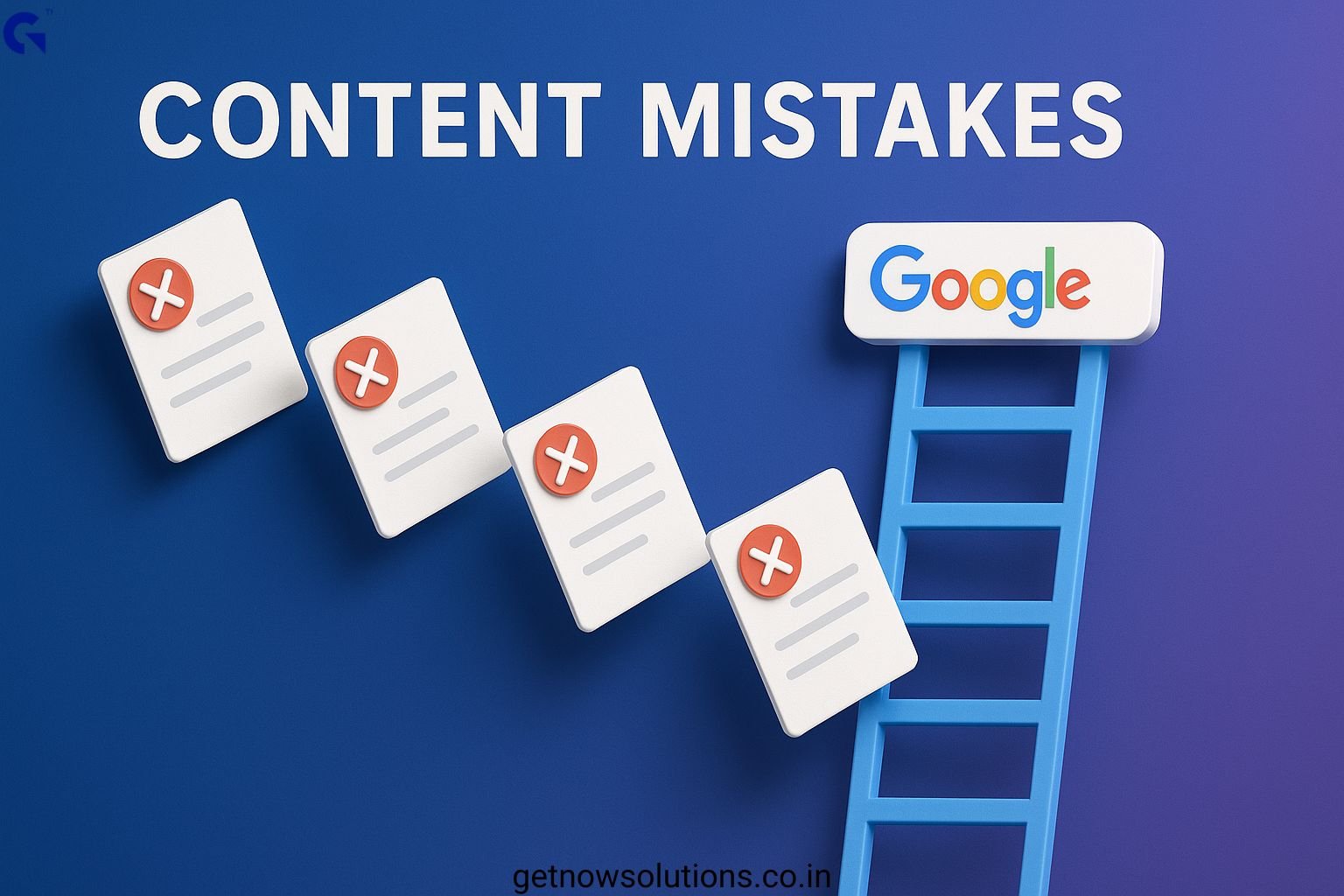
Let’s Talk About Why Your Content Isn’t Ranking
You know that sinking feeling when you’ve poured your heart into writing what you think is an amazing article, only to watch it disappear into the black hole of page 10 on Google? Yeah, I’ve been there too. And honestly? It’s frustrating as hell.
Here’s the thing though most of the time, it’s not that your writing is bad. It’s that you’re making a few critical mistakes that are basically telling Google, “Hey, please ignore this content!” The good news? These mistakes are totally fixable once you know what to look for.
So grab your coffee, get comfortable, and let’s dive into the five biggest content writing mistakes that are silently destroying your rankings. Trust me, by the end of this, you’ll know exactly what to fix.
Mistake 1: You’re Writing for Search Engines, Not Humans
Let’s start with the biggest mistake I see everywhere – writing like a robot trying to impress another robot. You know what I’m talking about: those articles stuffed with keywords that read like someone had a thesaurus accident.
Here’s what actually happens when you write primarily for search engines: Google gets smarter every single day, and it can smell keyword stuffing from a mile away. More importantly, real humans land on your page, realize it reads like a technical manual written by aliens, and bounce faster than you can say “SEO.”
What to do instead: Write like you’re explaining something to your friend over drinks. Use your target keywords naturally – they should flow in the conversation, not stick out like a sore thumb. If you’re forcing a keyword into a sentence where it doesn’t belong, you’re doing it wrong.
Think about it this way: would you actually say “best digital marketing strategies for small businesses” three times in casual conversation? Probably not. So don’t force it into every other paragraph of your article.
Mistake 2: Your Content Is Thinner Than a Piece of Paper
We’ve all seen those 300-word blog posts that barely scratch the surface of a topic. Maybe you’ve even written a few yourself (no judgment – we all have). But here’s the brutal truth: thin content is like showing up to a potluck with a single cracker. Nobody’s impressed.
Google wants comprehensive, valuable content that actually answers people’s questions. If someone searches for “how to start a blog” and lands on your 250-word fluff piece that basically says “pick a topic and write stuff,” they’re going to hit that back button so fast.
The fix is simple: Go deep. Cover your topic thoroughly. Answer the obvious questions, then answer the questions people don’t even know they should be asking. Look at what’s currently ranking for your topic and think, “How can I make something even better?”
But here’s the catch – length for length’s sake is also pointless. A 3,000-word article full of fluff is just as bad as a 300-word article with no substance. Quality and comprehensiveness matter more than hitting some arbitrary word count.
Mistake 3: You’re Ignoring the Technical Stuff (And It Shows)
Okay, I get it. Title tags, meta descriptions, header tags – this stuff sounds boring and technical. But ignoring these elements is like building a beautiful house and forgetting to install the front door. People (and Google) need a way to understand what’s inside.
Your title tag is literally the first impression your content makes in search results. If it’s something generic like “Blog Post #47” or missing your main keyword entirely, you’re shooting yourself in the foot before anyone even clicks.
And those header tags? They’re not just there to make your content look pretty. They help both readers and search engines understand the structure of your content. Using them properly is like giving everyone a roadmap through your article.
Here’s what you need to do: Make sure every piece of content has a compelling title tag with your main keyword in it. Write meta descriptions that make people want to click. Use header tags (H1, H2, H3) to organize your content logically. It takes an extra five minutes, but it makes a massive difference.
Mistake 4: Your Content Reads Like a College Textbook
Remember those textbooks from school that made you want to take a nap after two paragraphs? Don’t write like that. Please, for the love of all things readable, don’t write like that.
I see this mistake constantly smart people who know their stuff inside and out, but they write in this formal, dense style that makes readers’ eyes glaze over. Long paragraphs, complex sentences, fancy jargon… it’s a recipe for disaster.
Here’s a reality check: people are skimming your content. They’re probably on their phone, maybe sitting on the couch or waiting for their coffee. They don’t want to decode your sentences like they’re breaking the Enigma code.
Make your content scannable: Use short paragraphs (like, really short – 2-3 sentences max). Break up text with subheadings. Add bullet points when listing things. Use simple language that your grandma would understand. And for Pete’s sake, leave some white space on the page so it doesn’t look like a wall of text.
Think conversational, not corporate. Ask questions. Use contractions. Write the way you actually talk. Your content should feel like a helpful conversation, not a lecture.
Mistake 5: You Hit Publish and Never Look Back
This is the mistake that sneaks up on people. You write a great article, it ranks well, you move on to the next thing. Meanwhile, that article is slowly becoming outdated, losing relevance, and dropping in rankings.
The internet moves fast. What was accurate and comprehensive six months ago might be missing crucial updates today. Statistics change. Best practices evolve. New information emerges. If you’re not updating your content regularly, you’re basically telling Google it’s no longer relevant.
The solution: Set reminders to review your top performing content every few months. Update statistics. Add new sections about recent developments. Refresh examples. Sometimes, a simple update can bring a declining article back to life and restore its rankings.
Think of your content library like a garden – it needs regular maintenance to keep thriving. You wouldn’t plant flowers once and never water them again, right?
Wrapping This Up
Look, creating content that ranks well doesn’t require some secret formula or insider knowledge. It’s really about avoiding these common mistakes and focusing on creating genuinely helpful content that serves your readers.
Stop overthinking the SEO part and start thinking about what your audience actually needs. Write naturally, cover topics thoroughly, pay attention to the technical basics, make your content readable, and keep it updated. Do these things consistently, and the rankings will follow.
The beautiful thing? You can start fixing these mistakes today. Pick one article, audit it against these five mistakes, make improvements, and watch what happens. You’ve got this.